How to manufacture ultra-precise, almost identical elements, save on material – and on a mass scale? Just put a dedicated milling device to work. You can implement it in your own plant or outsource the work to an external company (e.g., like ours). But first – acquire a bit of information about it. Everything about the purpose, specifics, and operation of CNC milling machines – in one place. Get to know the strong and weak points, the potential of these devices, and much more.
What are CNC milling machines and what are they used for? Construction and components.
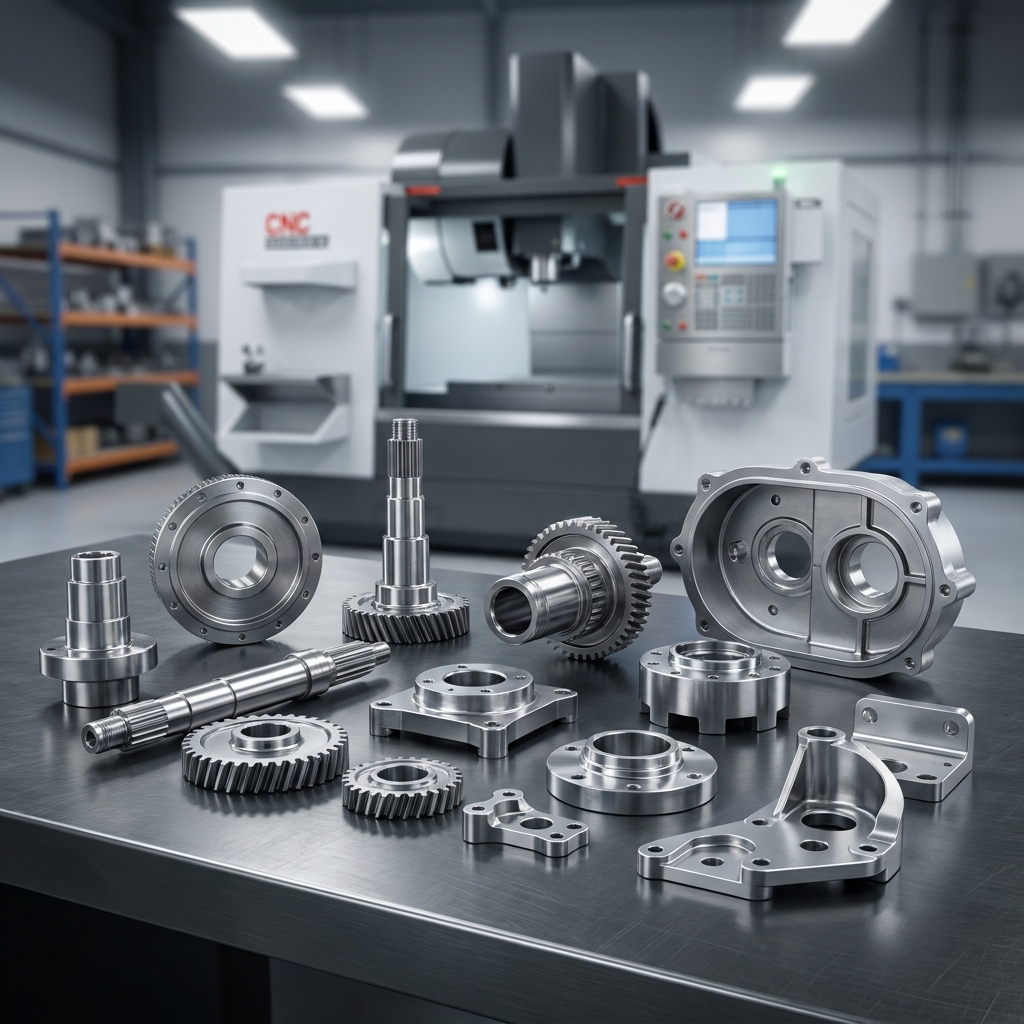
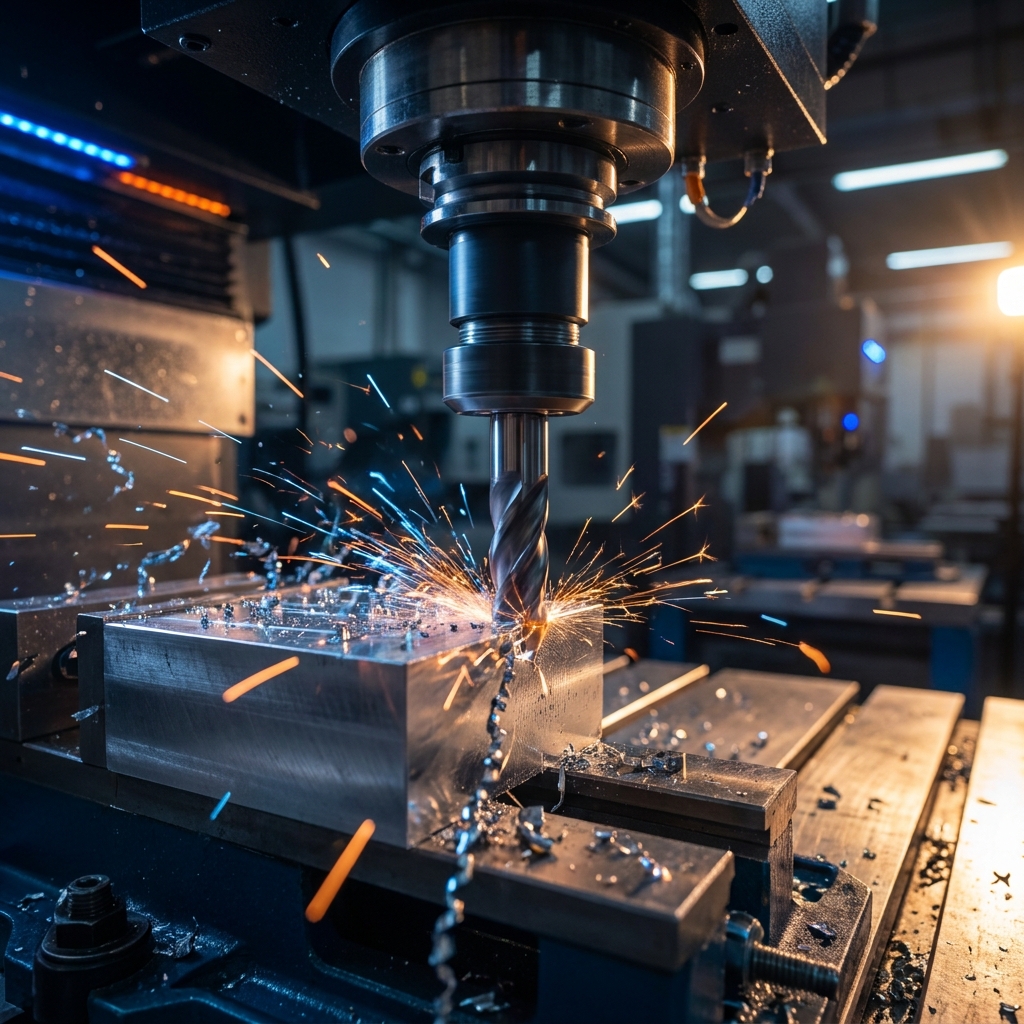
A CNC milling machine is a popular device that, using numerical control, is responsible for machining various types of materials – in several axes. For this purpose, it uses so-called cutters (mills), i.e., rotating tools. Such solutions are reached for in areas where repeatability, precision, and production scalability count. The technology allows for performing hundreds, or even thousands – of identical elements. At the same time, without losing anything in accuracy and their general quality.
Typical milling machines consist of several elements. These are:
- spindle – responsible for rotating the cutter,
- motors – driving the machine axes, thanks to which the cutters themselves can also move,
- work table (e.g., with a vise) – for mounting the material,
- frame and guides – guaranteeing structural rigidity,
- control system – executing the program and controlling operating parameters,
- operator panel – allowing starting, stopping, and monitoring the process,
- cooling and lubrication system – dissipating heat and facilitating waste removal,
- sensors – monitoring tool positions and general operating status, also protecting against potential collisions.
Types of CNC milling machines – vertical, horizontal, and others
The most basic types include:
- Vertical milling machine – compact, universal, and easy to use. Works well for prototype production and short series.
- Horizontal milling machine – advanced. Recommended for manufacturing larger elements and more mass production.
Apart from the above-mentioned, there are also so-called gantry (bridge) milling machines and table milling machines. The former are advanced solutions that work well when machining very large elements. The latter are more compact, which makes them applicable, e.g., in small workshops and with limited space.
How does a milling machine function? Description of operation.
Everything begins at the stage of mounting the material. Then the “controls” are taken over by the computer, which will adjust the rotational speed of the cutting tools programmed in the NC code, as well as the position of the workpiece (usually moving it along the X, Y, and Z axes).
The CNC milling machine operator is responsible for preparing the machine, loading material, and supervising the work. The rest happens automatically, and the process itself is repeatable. This allows ensuring that every subsequent detail is identical.
Types of cutters used
At the outset, we must note that cutters can be divided into several categories.
- First – based on their shape, and consequently – their purpose. This group includes cylindrical, face, angle, disk, end mills, modular, threading cutters, and a modern type becoming standard – barrel cutters.
- Second – taking into account the geometry of the blades used. Here we should mention ball, roughing, drilling, and radius cutters.
- Third – considering the material of manufacture. They are most often produced from high-speed steel and sintered carbide. There are also so-called diamond and ceramic cutters.
- Fourth (last division) – due to the type of coating covering the cutters. They are responsible for tool life in relation to the machined type of metal.
What materials can be machined?
The wealth of types means that CNC milling machines (after using the appropriate cutter, of course) can successfully handle a really impressive group of materials and raw materials. Of course, each of them poses quite different challenges (cutter type, feed parameters, operating temperature, etc.). And so:
- Metals (aluminum, carbon steel, stainless steel, copper, bronze, titanium) – are solid, require effective cooling.
- Plastics (ABS, PVC, polycarbonate, PMMA) – are easy to machine but require caution (risk of melting).
- Wood (and wood-based materials) – simple to mill, but generates dust and waste.
- Composites (carbon fibers, laminates) – need caution.
Where are they popular? Application of CNC milling machines in various industries.
Such technology finds particular application primarily in many industrial sectors: automotive, electronics, medicine, jewelry, and even furniture making. Worth noting – CNC flexibility allows supporting small, medium, as well as quite large businesses. It works well for scaled production and successfully allows realizing small series and prototypes (valued by startups and smaller organizations).
Milling machining compared to other methods – how does it differ?
The biggest “competitor” in this field is certainly turning – and we will compare milling with it. The difference between them lies in the method of operation. In a CNC lathe, the object/element itself rotates. In a milling machine – the tool is set in motion.
This makes turning ideal for rotationally symmetrical parts. Milling, on the other hand, handles arbitrary geometries and allows for greater complexity of shapes. It is universal, thanks to which you can perform more operations using one machine.
When is it worth it, and when not? Strengths and weaknesses of CNC milling machines.
What speaks “for” it? First of all, the fact that such devices give you the possibility to make any shapes and geometries. Another plus is the repeatability of the series, shortening of work time (especially compared to manual machining), and a significantly smaller number of defects. A CNC milling machine is capable of working 24/7 (while maintaining only minimal supervision and control). In this way, efficiency increases.
But at the same time… you must take into account certain “inconveniences”. First are the high costs – initial, related to purchase, and operational, related to maintenance, service, and upkeep of the machine. Add to this that you will need qualified specialists (CNC operators and programmers). The long preparation time means that the true potential of CNC milling machines is released with larger productions. Therefore, perhaps, they will not be the best choice for small or one-off orders.
Do you need precise elements?
If you are looking for a partner who will make them for you – we are at your disposal. At the Maximus CNC facility in Warsaw, we have a modern machine park and an experienced team operating it. We are able to undertake even the most demanding and complex projects. Do you have one? Do not wait and contact us today to learn the details and establish further stages of cooperation.