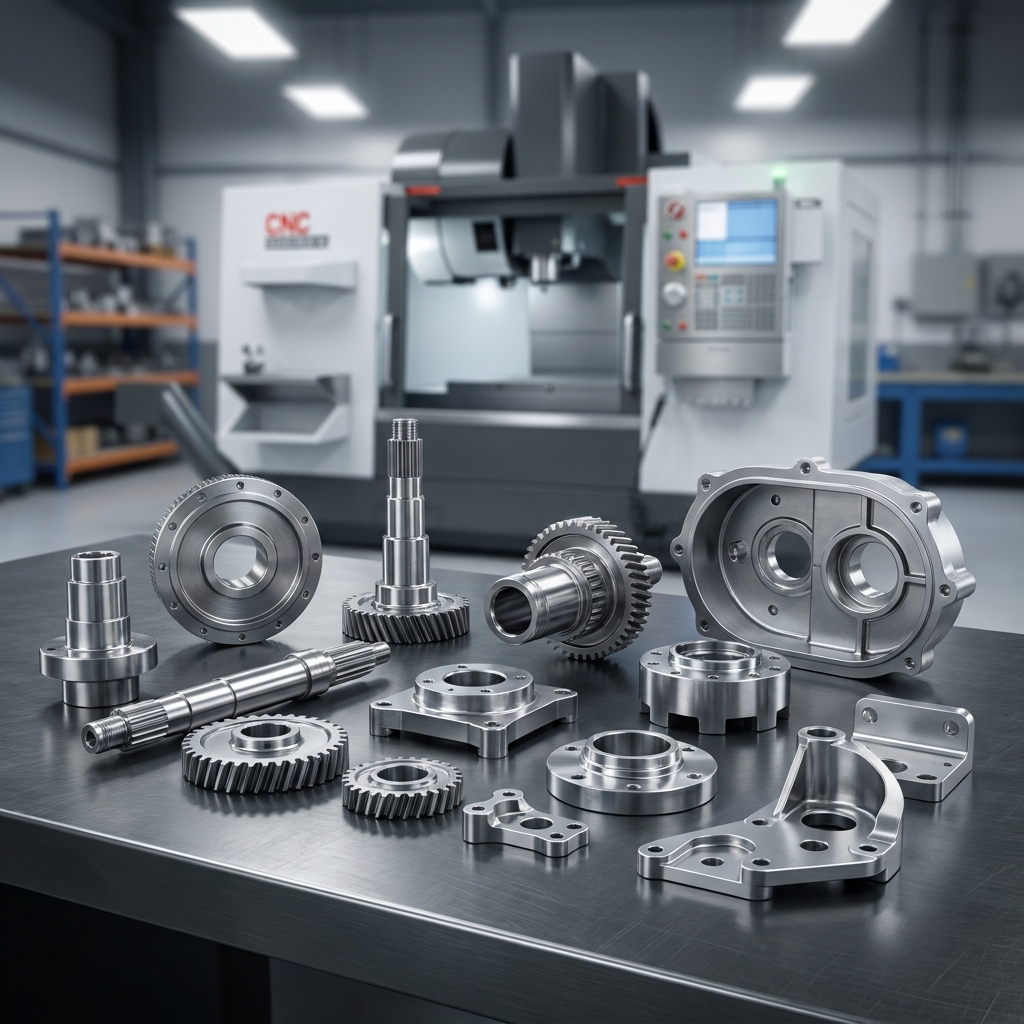
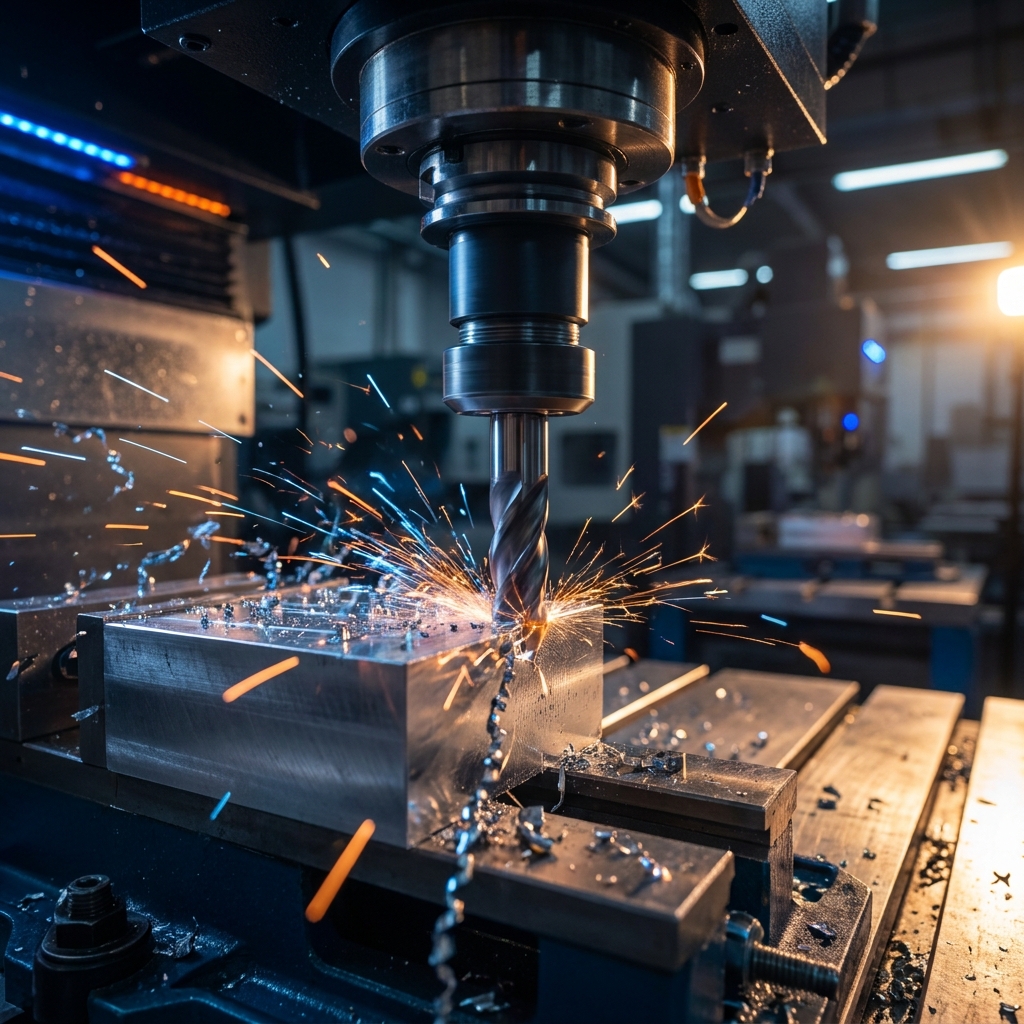
Does this abbreviation still remain a mystery to you? In this publication, we will explain not only its literal meaning, but above all – what such a system consists of and how it is used in practice. How does this technology affect the functioning of modern industry? Get to know the operating principles, machines, and even materials used in CNC machining.
What is CNC technology?
CNC is an abbreviation derived from the words “Computer Numerical Control”. Its history reaches back to the 1950s, where it was a response to the growing needs of the aviation industry, which – let us remind you – required a very, very high level of precision and production repeatability.
CNC answered (and continues to answer) these requirements. In practice, it is responsible for the work of machine tools. Exactly so that every produced element is consistent with the instruction (design). In this way, in many branches of industry and beyond – CNC replaced the necessity of manual tool operation. Not only accelerating production but also – minimizing errors (especially human ones) and the necessity of introducing corrections. It also opened new possibilities for companies. Companies gained the ability to manufacture complex elements that were previously very difficult or unfeasible, and their production – unprofitable. Currently, numerical control constitutes the foundation of modern production in many industries. Areas such as automotive, medicine, electronics, and the broadly understood industry benefit from it.
Types of CNC machines
At this point, we must clearly state that modern industry reaches for and actively uses at least several basic types of so-called machine tools. Each of them has its unique application – and so we distinguish:
- CNC Lathes – dedicated to machining rotational elements (shafts, sleeves, screws).
- CNC Milling Machines – universal machines for machining wood, metal, and plastics.
- CNC Plotters – intended for performing activities related to engraving, scoring, or drilling.
As is easy to guess – each of the above-mentioned types of CNC devices finds application in different areas. Of course, we successfully use some of them also in the Warsaw Maximus CNC facility.
What does such a system consist of? The main components are:
As the name suggests, a CNC “system” is actually a collection of various solutions. These include components such as:
- control computer (interprets the program and generates control signals for other elements),
- communication interfaces (enable sending programs from external devices and monitoring machine operation in real-time),
- operator panel (allows entering parameters, starting programs, and controlling the entire machining process),
- motors (convert electrical signals into movements of individual axes),
- sensors (monitor the tool position and transmit this data “higher up” – to the control computer),
- mechanisms (lead screws, linear guides, gears, which ensure smooth movement),
- machining tools (cutters, lathe tools, etc.) – responsible for the actual realization of the material removal process).
What materials can be machined on CNC devices?
Machine tools, depending on the needs and specifics of a given company, can successfully deal with different types of raw materials. Key ones include:
- Metals (most popular), including: steel, aluminum, brass, copper, titanium. Due to their specifics – they require additional cooling.
- Wood and wood-based materials. Can be machined at high speeds.
- Plastics, including: ABS, PMMA, polycarbonate. Due to the risk of melting – must be machined while maintaining lower cutting speeds.
- Composites (carbon fiber, bakelite). These require the use of special diamond tools.
Among the more demanding, and consequently – less popular, we also include various types of ceramic materials and glass. Their machining is definitely more difficult because, due to hardness and brittleness – it must take place using diamond tools. Moreover, it requires the use of water cooling.
CNC in production – advantages, disadvantages, and limitations
Numerical control can bring very tangible benefits – expressed in mass production, speed, as well as lower costs. Among the main “pluses” of this technology, we can successfully include:
- Precision and repeatability – a properly designed system is capable of creating hundreds, or even tens of thousands of practically identical elements (execution accuracy oscillates within the limits of 0.01 mm to even 0.001 mm).
- Lead time is drastically shortened (especially if we compare it with “manual” machining). Additionally, CNC machines can work practically uninterrupted – 24 hours a day and 7 days a week. Only with breaks for potential checks or “retooling”.
- Impressive capabilities – such devices are capable of machining even the most complex spatial shapes.
- Material savings – thanks to the option of precise planning, the amount of waste is really minimal (which limits expenses).
However, so that it is not so “colorful” – the technology also has several weaker sides, which – as specialists in this field – we must also mention and describe. These are, for example:
- High (and very high) costs – the so-called entry barrier is large. If you want to invest in a professional machine tool – prepare for huge expenses. If not – outsource this task to our company!
- Need for qualified staff – without the knowledge and skills of operators and programmers, even the best equipment will remain just a useless “toy”.
- Scale requirement – due to the relatively long preparation time, true benefits are seen only in the production of large series. For small series (e.g., a few to a dozen pieces) – manual machining may still turn out to be more profitable.
- Maintenance (maintenance and calibration) – machines of this type are not only expensive to purchase but also require significant investment related to their service. Here we must also mention the costs of licenses and training for personnel.
CNC vs traditional manual machining – how do they differ?
The fundamental difference is, of course… accuracy. One can say that manual devices (with a tolerance of 0.1 mm – 0.5 mm) play in a completely different league than CNC (with a tolerance at the level of 0.01 mm – 0.001 mm). Besides, there are also aspects we have already mentioned in this article, namely: speed, repeatability, complexity, and scalability of production (all in favor of CNC).
Paradoxically, manual machining wins in the matter of flexibility – especially if we are talking about prototypes and smaller projects. While manual devices require the constant presence of an operator, CNC (after configuration and startup) is able to work independently (maintaining appropriate supervision).
Do you need precise elements made in CNC technology?
Okay, it looks like after reading this article (and we hope you managed to read it in its entirety) you already know what it is, how it works, and what possibilities CNC technology offers. If you now want to use them in practice (e.g., for the needs of your company) – we invite you to contact us. At Maximus CNC, we have a modern machine park and experienced staff. Thanks to this, for years we have been successfully realizing demanding projects in the field of milling, turning, and machining.